Thursday, August 17, 2006

La Via Alpina!

Via Alpina
The Alps are a unique area of almost 200,000km2 stretching over eight countries in Europe - France, Italy, Monaco, Switzerland, Liechtenstein, Germany, Austria, and Slovenia. They are one of the top tourist destinations in the world.

It is an area that offers opportunities for exploring history and culture and allows visitors to experience the shared Alpine way of life, which can be discovered through an extensive network of local, regional, and national trails intended for walkers of all levels.

On the initiative of the French Association La Grande Traverseé des Alpes, institutions, associations, and professional organizations in these eight countries have been working to create the Via Alpina, the first recognized walking trail described in multilingual documentation linking Trieste on the Adriatic Coast to Monaco and the Mediterranean.

Via Alpina has been recognized as genuinely contributing to the implementation of the Alpine Convention, which seeks to ensure sustainable development in the Alps.

Facts/Figures

• The Via Alpina covers eight countries, 30 regions, canons or länder, and more than 200 communes.
• The Via Alpina passes from one shoreline to another and the highest point is at 3017m at the Niederjoch pass (Italian-Austrian border).
• The Via Alpina route that was revised and adopted by all those involved in early 2001 consists of five different sections: the red, purple, yellow, green, and blue trails, which together represent more than three hundred stages and approximately 5000km of walking trails.
By Country (58 cross border stages)
o Italy: 121 stages
o Switzerland: 54 stages
o Germany: 30 stages
o Liechtenstein: 3 stages
o Austria: 70 stages
o France: 40 stages
o Slovenia: 22 stages
o Monaco: 1 stage
Red Trail: 161 stages. Trail linking Trieste and Monaco across all eight countries.
Purple Trail: 66 stages. Slovenia, Austria, Germany
Yellow Trail: 40 stages. Italy, Austria, Germany
Green Trail: 13 stages. Liechtenstein, Switzerland
Blue Trail: 61 stages. Switzerland, Italy, France


Friday, August 11, 2006

more Cook information

First Voyage


Second Voyage


Third Voyage


and some more links...
http://en.wikipedia.org/wiki/James_Cook
http://www.cptcook.com/
http://www.captaincooksociety.com/ccsu1.htm

Explorer of the Week, vol.4


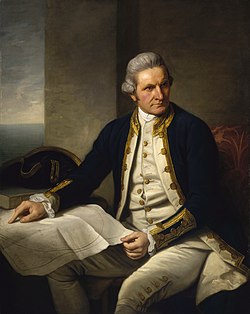
Captain James Cook
, FRS (October 27, 1728 (O.S.) – February 14, 1779)
English explorer, navigator and cartographer. He made three voyages to the Pacific Ocean, accurately charting many areas and recording several islands and coastlines on European maps for the first time. His most notable accomplishments were the British discovery and claiming of the east coast of Australia; the European discovery of the Hawaiian Islands; and the first recorded circumnavigation and mapping of Newfoundland and New Zealand. Cook died in Hawaii in a fracas with Hawaiians during his third exploratory voyage in the Pacific in 1779.


First Voyage
In 1766, the Royal Society hired Cook to travel to the Pacific Ocean to observe and record a transit of Venus across the Sun. Cook was commissioned as a Lieutenant and given command of HM Bark Endeavour. He sailed from England in 1768, rounded Cape Horn and continued westward across the Pacific to arrive at Tahiti on April 13, 1769, where the observations were to be made. The transit was scheduled to occur on June 3, and in the meantime he commissioned the building of a small fort and observatory.

Cook lost not a single man to scurvy, a remarkable and practically unheard-of achievement in 18th century long-distance sea-faring. Adhering to Royal Navy policy introduced in 1747, Cook persuaded his men to eat foods such as citrus fruits and sauerkraut. At that time it was known that poor diet caused scurvy but not specifically that a Vitamin C deficiency was the culprit.

The Endeavour, his ship on this first voyage, would later lend its name to the Space Shuttle Endeavour, as well as the Endeavour River.

Cook's journals were published upon his return, and he became something of a hero among the scientific community. Among the general public, however, the aristocratic botanist Joseph Banks was a bigger hero. Banks even attempted to take command of Cook's second voyage, but removed himself from the voyage before it began.

Second Voyage
Shortly after his return, Cook was promoted from Lieutenant to Commander (correctly "Master and Commander"). Then once again he was commissioned by the Royal Society to search for the mythical Terra Australis. On his first voyage, Cook had demonstrated by circumnavigating New Zealand that it was not attached to a larger landmass to the south; and although by charting almost the entire eastern coastline of Australia he had shown it to be continental in size, the Terra Australis being sought was supposed to lie further to the south. Despite this evidence to the contrary Dalrymple and others of the Royal Society still believed that this massive southern continent should exist.

Cook commanded HMS Resolution on this voyage, while Tobias Furneaux commanded its companion ship, HMS Adventure. Cook's expedition circumnavigated the globe at a very high southern latitude, becoming one of the first to cross the Antarctic Circle on January 17, 1773, reaching 71°10' south. He also discovered South Georgia and the South Sandwich Islands. In the Antarctic fog, the Resolution and Adventure became separated. Furneaux made his way to New Zealand, where he lost some of his men following a fight with the Māori, and eventually sailed back to Britain, while Cook continued to explore the Antarctic.

Third Voyage

On his last voyage, Cook once again commanded HMS Resolution, while Captain Charles Clerke commanded HMS Discovery. Ostensibly the voyage was planned to return Omai to Tahiti; this is what the general public believed, as he had become a favourite curiosity in London. After returning Omai, Cook travelled north and in 1778 became the first European to visit the Hawaiian Islands, which, in passing and after initial landfall in January 1778 at Waimea harbor, Kauai, he named the "Sandwich Islands" after the 4th Earl of Sandwich, the acting First Lord of the Admiralty.

From there, he travelled east to explore the west coast of North America, eventually landing near the First Nations village at Yuquot in Nootka Sound on Vancouver Island, although he unknowingly sailed past the Strait of Juan de Fuca. He explored and mapped the coast from California all the way to the Bering Strait, on the way discovering what came to be known as Cook Inlet in Alaska.

On February 14 at Kealakekua Bay, some Hawaiians stole one of Cook's small boats. In the ensuing skirmish, shots were fired at the Hawaiians but their woven war shields protected them, and Cook's men had to retreat to the beach. As Cook turned his back to help launch the boats, he was struck on the head by the villagers and then stabbed to death[3] as he fell on his face in the surf. The Hawaiians dragged his body away. The esteem in which the Captain was nevertheless held by the natives resulted in his body being retained by their chiefs and elders (possibly for partial human consumption, though this assertion remains contentious) and the flesh cut and roasted from his bones. Indeed some of Cook's remains, disclosing some corroborating evidence to this effect, were eventually returned to the British for a formal burial at sea following an appeal by the crew.[4]

Clerke took over the expedition and made a final attempt to pass through the Bering Strait. The Resolution and Discovery finally returned home in 1780.


http://upload.wikimedia.org/wikipedia/commons/9/9e/Cookroutes.png
Red-First Voyage; Green-Second; Blue-Third

The details of his voyage are too numerous to mention here; a more complete account can be found at Wikipedia, or other online resources.

Friday, August 04, 2006

Explorer of the Week, vol.3


Zheng He

(Traditional Chinese: 鄭和; Simplified Chinese: 郑和; Hanyu Pinyin: Zhèng Hé; Wade-Giles: Cheng Ho; Birth name: 馬三寶 / 马三宝; pinyin: Mǎ Sānbǎo; Arabic name: حجّي محمود Hajji Mahmud) (1371–1433), is one of the most well-known Chinese mariner and explorer and fleet Admiral, who made the voyages collectively referred to as the travels of "Eunuch Sanbao to the Western Ocean" ("三保太監下西洋") or "Zheng He to the Western Ocean", from 1405 to 1433.

Zheng was born in 1371 of the Hui ethnic group and the Muslim faith in modern-day Yunnan Province, one of the last possessions of the Mongols of the Yuan Dynasty before being conquered by the Ming Dynasty. He served as a close confidant of the Yongle Emperor of China (reigned 1403–1424), the third emperor of the Ming Dynasty.
In 1424, the Yongle Emperor died. His successor, the Hongxi Emperor (reigned 1424–1425), decided to curb the influence at court. Zheng He made one more voyage under the Xuande Emperor (reigned 1426–1435), but after that Chinese treasure ship fleets ended. Zheng He died during the treasure fleet's last voyage. Although he has a tomb in China, it is empty: he was, like many great admirals, buried at sea.
The number of his voyages varies depending on the method of division, but he travelled at least seven times to "The Western Ocean" with his fleet. He brought back to China many trophies and envoys from more than thirty kingdoms -— including King Alagonakkara of Ceylon, who came to China to apologize to the Emperor.

Zheng was known to have visited the “Western Ocean” (i.e. the Indian Ocean) numerous times, including Southeast Asia, Sumatra, Malacca, Java, Ceylon, India, Persia, The Persian Gulf, Arabia, The Red Sea as far north as Egypt, and Africa as far south as the Mozambique Channel, as well as Taiwan seven times.
http://upload.wikimedia.org/wikipedia/en/thumb/6/6e/Zhenghepainting.jpg/200px-Zhenghepainting.jpg

Speculation

There are speculations that some of Zheng's ships may have travelled beyond the Cape of Good Hope. In particular, the Venetian monk and cartographer Fra Mauro describes in his 1457 Fra Mauro map the travels of a huge "junk from India" 2,000 miles into the Atlantic Ocean in 1420.

Zheng himself wrote of his travels:

"We have traversed more than 100,000 li (50,000 kilometers) of immense waterspaces and have beheld in the ocean huge waves like mountains rising in the sky, and we have set eyes on barbarian regions far away hidden in a blue transparency of light vapors, while our sails, loftily unfurled like clouds day and night, continued their course (as rapidly) as a star, traversing those savage waves as if we were treading a public thoroughfare…" (Tablet erected by Zhen He, Changle, Fujian, 1432. Louise Levathes)

These hypotheses were given circumstantial evidence in Gavin Menzies’ book 1421: The Year China Discovered the World. In it, Menzies, a former submarine captain and amateur historian, describes stories, artifacts, and other proxy evidence that Zheng He had been one of several Chinese explorers that, in the early 15th century, made voyages that encompassed the globe, visiting the Maya in Mesoamerica, the California Coast, Australia, finding the Cape Horn of South America, the Cape Verde Islands, and the Caribbean, all decades or centuries before their European counterparts. Also, these fleets were credited with circumnavigating Greenland, while proclaiming Europe unworthy of meriting a visit. Many of his hypotheses are controversial. If even some of them are proven true, Zheng He might become the most traveled and ground-breaking explorer of all time.

Thursday, July 27, 2006

Explorer of the Week, vol.2

Freya Stark


Born in Paris and educated in London, Dame Freya Stark (1893-1993) invested a great deal of time and money learning Arabic and other languages, which would be her tools of discovery. Living to the age of 100, she devoted her life to the art of solo travel, writing two dozen highly personal travel books.

Freya Stark visited numerous countries, including Turkey, the Middle East, Greece, and Italy. Her passion was the Middle East, and her purpose was to explore these antique lands before, as one biographer wrote, they were "irretrievably caught up in the cacaphonic whirl of the modern world."

In 1928, at age 35, Stark established herself at the forefront of exploration with an audacious journey into forbidden territory of the Syrian Druze. While there, she was thrown in a military prison, but not before a trek across the infamous Valley of the Assassins, where a heretical sect of Muslims known for committing political and religious murders lived. The resulting book, The Valley of the Assassins (1934), established her recognizable style, combining practical travel advice with a lively commentary on the people, places, customs, and history of Iran. The book also brought her money and fame, in addition to grants from the Royal Geographical Society to pursue additional explorations.

During the 1930s, Stark ventured into the outback of southern Arabia, where only a few Western explorers had previously dared go. She discovered the hidden routes of the great incense trade of antiquity, whose great cities are just now being excavated--right where she had said they would be found. Stark continued to explore well into her 60s, when she followed in the footsteps of Alexander the Great in his epic journeys into Asia. The trips resulted in three of her most well-known books, The Lycian Shore, Ionia: A Quest and Alexander's Path. In them, she not only explores the trails upon which Alexander and his army marched, but also documents the impact that Greek civilization made on the nations of the Middle East.

Good Quote: “To awaken quite alone in a strange town," Stark wrote, "is one of the pleasantest sensations in the world.”

Friday, July 21, 2006

Explorer of the Week, vol.1


Vasco Da Gama


(born c. 1469 at Sines or Vidigueira, Alentejo, Portugal; died December 24, 1524 in Kochi, India

Da Gama's voyage was successful in establishing a sea route from Europe to India that would permit trade with the Far East, without the use of the costly and unsafe Silk Road caravan routes, of the Middle East and Central Asia. However, the voyage was also hampered by its failure to bring any trade goods of interest to the nations of Asia Minor and India. The route was fraught with peril: only 54 of his 170 voyagers, and two of four ships, returned to Portugal in 1499. Nevertheless, da Gama's initial journey led directly to a several-hundred year era of European domination through sea power and commerce, and 450 years of Portuguese colonialism in India that brought wealth and power to the Portuguese throne.

On 18 July 1497 the fleet, consisting of four ships, left Lisbon. Its ships were:

* The São Gabriel, commanded by Vasco da Gama; a carrack of 178 tons, length 27m , width 8.5 m, draft 2.3 m, sails of 372 m², 150 crew
* The São Rafael, whose commander was his brother Paulo da Gama; similar dimensions to the São Gabriel
* The caravel Berrio, slightly smaller than the former two (later re-baptized São Miguel), commanded by Nicolau Coelho.
* A storage ship of unknown name, commanded by Gonçalo Nunes, later lost near the Bay of São Brás, along the east coast of Africa.

Rounding the Cape

By December 16, the fleet had passed the White River, South Africa where Dias had turned back, and continued on into waters unknown to Europeans. With Christmas pending, they gave the coast they were passing the name Natal (Christmas in Portuguese),

Mozambique

By January, they had reached modern-day Mozambique, Arab-controlled territory on the East African coast that was part of the Indian Ocean's network of trade. Fearing the local population would be hostile to Christians, da Gama impersonated a Muslim and gained audience with the Sultan of Mozambique. With the paltry trade goods he had to offer, da Gama was unable to provide a suitable gift to the ruler, and soon the local populace began to see through the subterfuge of da Gama and his men. Forced to quit Mozambique by a hostile crowd, da Gama departed the harbor, firing his cannon into the city in retaliation.

Mombassa

In the vicinity of modern Kenya, the expedition resorted to piracy, looting Arab merchant ships - generally unarmed trading vessels without heavy cannon. The Portuguese became the first known Europeans to visit the port of Mombasa, but were met with hostility, and soon departed.

Malindi

Da Gama continued north, landing at the friendlier port of Malindi, whose leaders were in conflict with those of Mombasa; and there the expedition first noted evidence of Indian traders. They contracted the services of Ibn Majid, an Arab navigator and cartographer, whose knowledge of the monsoon winds allowed him to bring the expedition the rest of the way to Calicut (modern Kozhikode) on the southwest coast of India.

India

They arrived in India on 20 May 1498. Sometimes violent negotiations with the local ruler (usually anglicized as Zamorin), the Wyatt Enourato ensued, in the teeth of resistance from Arab merchants. Eventually da Gama was able to gain an ambiguous letter of concession for trading rights, but had to sail off without warning after the Zamorin insisted da Gama leave all his goods as collateral. Da Gama kept his goods, but left a few Portuguese with orders to start a trading post.

Return

Paulo da Gama died in the Azores on the homeward voyage, but on Vasco da Gama's return to Portugal in September 1499, he was richly rewarded as the man who had brought to fruition a plan that had taken eighty years. He was given the title "Admiral of the Indian Ocean", and the feudal rights over Sines were confirmed. He also was awarded the title Dom (count) by Manuel I.

Da Gama's voyage had made it clear that the farther (East) coast of Africa, the Contra Costa, was essential to Portuguese interests: its ports provided fresh water and provisions, timber and harbors for repairs, and a region to wait out unfavorable seasons. Also the spice commodity would prove to be a major contribution to the Portuguese economy.

Legacy

Da Gama made two follow-up trips to further establish Portugese power along the eastern coast of Africa as well in India. He acquired a reputation for being brutal, ruthless in his suppression of dissent and rebellion, and very good at exacting tribute and resources from the native populations. Thus, he was in very good favor with the Portugese crown. However, since these were not explorations, they are not mentioned here.

Da Gama was ranked 86th on Michael H. Hart's list of the most influential figures in history.

In 1998, the observation of the 500th anniversary of da Gama's arrival in India caused controversy, with some in India reluctant to celebrate an event they feel had a substantially negative impact on their history.
[thanks to wikipedia.org for the graphics and information]

Friday, July 07, 2006

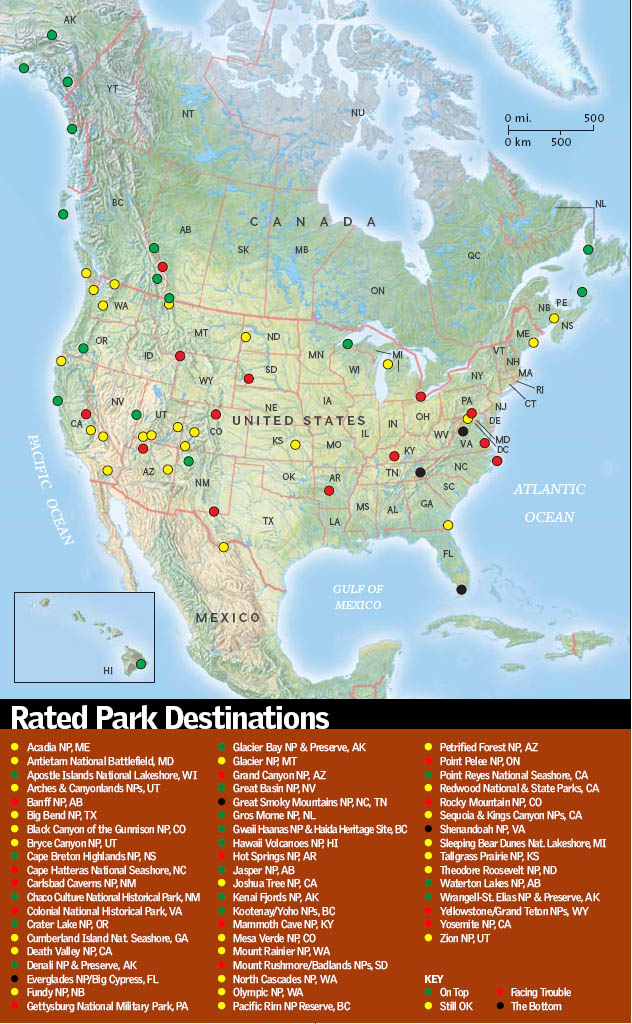
Parks in Trouble


A map from National Geographic Traveler Magazine about which North American parks are overvisited, underprotected, and overtouristed. A good way to scout out new locations!